


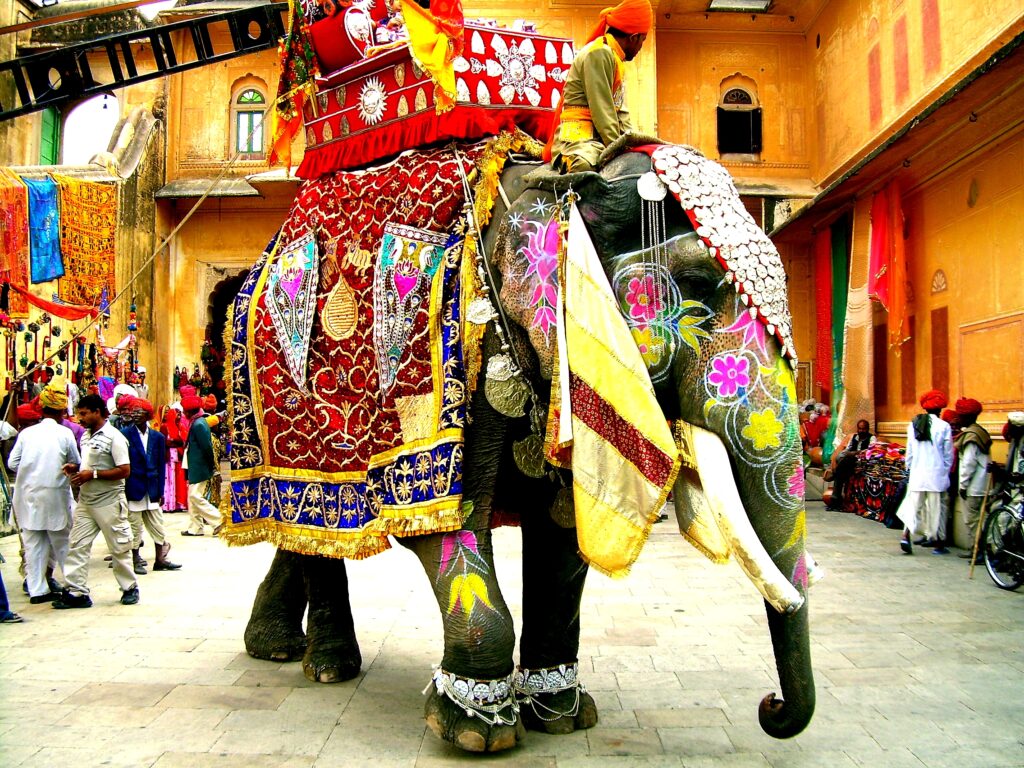
Temple/Devaswam Elephants
A DNA census carried out found that elephant numbers were down by 25% in 8 years and India was home to 22,446 wild jumbos in 2025. (The DNA-recapture method uses material such as dung to identify individual animals and create genetic profiles.)
India had about 27,000 wild and 2,675 (as per a RTI filed in 2019) captive elephants. The wild elephants live in 32 elephant reserves covering 69,582 sq kms that are unfortunately identified by the government as a programme only which means they get insufficient legal protection. In 2017 their population continued to remain stable at 29,964 as in 2012.
Reference the above figure of 2454 elephants in captivity 560 were in possession of Forest Departments, 1687 with private individuals, 85 in zoos, 26 in circuses and 96 in temples. However, 664 from among these were without ownership certificates. Furthermore, as many as 915 captive elephants were in Assam and 518 in Kerala.
It is unfortunate that the Indian temple elephant is certainly not happy in what it is made to do, much as its role is glorified. Temples cite tradition for keeping elephants, but where was this tradition even a century back? Maharajas kept elephants, yes, but… for example the Guruvayoor temple, near Thrissur in Kerala, had no elephants before 1969. Hindus undergoing hard times due to land reforms had no choice but to donate the elephants they were unable to take care of to the temple. That’s how Kerala’s temple elephants came into being, as did the Devaswam Boards. Elephants are not kept for religious reasons. They are there for commercial gain.
The season for temple-festivals/vela/pooram covers March, April and May (summer – the hottest months of the year) and processions with at least 3 and up to 15 temple elephants participating is a vital part of these celebrations. A growing trend is for churches and mosques to also organise elephant processions. A huge strain for temple elephants – they lose nearly 300 kgs in a single festive season.
One would imagine it is the job of the Kerala Forest Department to maintain records, but authentic information has been compiled by the Heritage Animal Task Force (Thrissur): between 2007 and 2013 as many as 2,896 times elephants displayed rogue behaviour, 425 elephants died due to ill-treatment by mahouts and 183 mahouts were killed by elephants that turned violent during temple festivals.
Cruelty
Temple/devaswam elephants, synonymous to Kerala (the state’s animal) have been subjected to cruelty in captivity for centuries. For example, elephant melas organised supposedly to attract tourism, are nothing but torment for the animals. 101 richly decorated temple elephants carrying ceremonial umbrellas participate in The Great Elephant March called Gajamela at Thrissur festival in Kerala every January. Elephants are known to be made to walk continuously for over 12 hours. And, upon their return have to bear the loud sounds of firecrackers exploding.
In March 2014, as many as 62 elephants participated in the annual aanayottam or elephant race that marks the beginning of the 10 day-long temple festival at the Guruvayoor temple – every year the number of elephants and spectators has been increasing. It is cruel because the elephants are forced to run fast for half a kilometre, enter the temple, circumambulate the sanctum sanctorum and touch the kodimaram (flag staff). And, the first one to do so is given the honour (sic!) of carrying the thidambu (replica of temple deity) during special occasions for the coming year.
The Krishna temple of Guruvayur is one of the five most famous Lord Krishna and Vishnu temples in India. And among the elephants that live in the 7 acre temple yard or annakotta, Padmanabhan is hailed as the superstar because he is the elephant who has been carrying the thidambu. He was given to the temple in 1954 – over 60 long and sad years in captivity. In 2015, 66 elephants, aged 14 to 70, owned by the temple were being looked after by some 200 mahouts. Renting them for festivals brings in money for the temple, e.g. Rs 3 lakh was paid for an elephant to participate for one day at a festival in Palakkad district.
An elephant without tusks is called mozha and is not accepted by temples. In a way they are the lucky ones, like Indrajith who was not donated to a temple or made to stand to attention close to flames at festivals when deafening drums were beaten and loud firecrackers burst, or even made to lug timber. At a camp in Konni (20 kms from Pathanamthitta) Indrajith and others are kept in semi-captivity and gradually taught how to adjust in the wild. Good intentions no doubt, but it is difficult to predict if attempts to rehabilitate elephants in the wild will be successful. Each elephant is an individual case, and if it is not accepted as a part of a wild elephant herd, it will remain a loner for life. Not having lived as part of a herd, captive elephants do not know elephant hierarchy or how to bond with other elephants. They have never had a chance of instinctively expressing themselves because of being forced into submission to act exactly as per the instructions given by their mahouts. Also, having never walked free for miles in the forest every day, the vastness and other wildlife could suddenly become overwhelming.
An elephant called Gajraj from the Pandharkawa camp escaped and killed in woman in October 2018. In November 2019 the same animal killed the helper of his mahout at the Tadoba Andhari Tiger Reserve. In-between in March 2019 he inured two persons. This goes to prove how stressed the animal was due to cruelty being inflicted upon him in order to tame him.
Flouting Laws
Temple/devaswam elephants are found in hundreds, although individuals in Kerala also own some elephants – considered a status symbol and called naat-anna or village elephant. They are usually purchased for up to Rs 40 lakhs each from North East India where logging is now banned and from where they are illegally captured (elephants rarely breed in captivity). They are then transported to Kerala in claustrophobic trucks, the journey lasting around fortnight. They come along with fictitious certificates stating that the calves were born in captivity. The Directorate of Forests, West Bengal also sells calves born to captive female elephants mated with wild tuskers – the females are set free into the jungle at night and brought back to camp in the morning.
May be this is what happened in 2017 when a wild elephant who was in musth came out of the Madukkarai range forest near Coimbatore, and trampled 4 people to death. This was not the first time that a rouge elephant had come out of the Madukkarai range.
Captive elephants are status symbols not only in Kerala and West Bengal, but in many other states too, like Bihar, Arunachal Pradesh, Uttar Pradesh, Karnataka and Tamil Nadu. Incidentally, in Bihar to control elephants, mahouts use a sharp axe-like device which cuts deep. Once domesticated, where ever they are, they used for labour and rented out to generate money. Temple elephants have vociferous fans based on their height (the taller the better), clean white tusks, tails like brushes, and long trunks that reach the ground. It is common to see both praise and nasty remarks about them on Facebook.
Torture
A man who takes care of and trains a captive elephant is called a mahout and his helper is a kavadi in Karnataka. Following a collective study it was reported in February 2013 that most mahouts and kavadis were alcoholics (resulting in elephants having to endure brutal behaviour) and suffered from ailments like TB. Their unhygienic habits resulted in passing on their ailments to the elephants. As there was a 29% shortage, temporary workers who did not know how to handle elephants (at the time Karnataka had 161 captive elephants) were employed.
Before reading further, please click here to see utterly cruel recommendations for controlling elephants from the FAO’s Elephant care manual for mahouts and camp managers.
The method of training temple/devaswam elephants in Kerala is called kumkies – submission by the carrot and stick method involving beating as punishment for disobedience and a piece of sugarcane for obedience. For example, Thechikkottukavu Ramachandran (who earns Rs 1.25 lakh per procession and annually rupees one crore) is the most celebrated elephant of Kerala, even though he is blind in one eye because of a mahout’s beatings. (It is said that many mahouts destroy the right eye to avoid elephants getting alarmed of moving vehicles when participating in parades.) He was brought from Bihar to Kerala at age 18 in 1983, made to forget the Bhojpuri language and forced to take instructions in Malayalam. That he has killed 5 mahouts and 5 others since 1988 is a story in itself, as is the fact that his mahout Shibu committed suicide in August 2015 after being accused of feeding the elephant rice from which he had removed razor blades. On seeing elephants being beaten black and blue at the training centre at Guruvayur, people have literally fled. It is here that one of the temple elephants has a foot-long deep groove on his remaining tusk (having lost one already – wonder what happened to the ivory) due to his constant but unsuccessful efforts to file his chains open and set himself free. An iron rod with hook called ankush is used on the sensitive points of their bodies to prod them: elephants have as many as 107 sensitive points, mainly on their head, back, feet and anal region. A tiny spear is also jabbed behind their ears to make them learn to obey human foot commands given by their mahout, who in the presence of visitors deftly replaces the pain-causing spears with small canes. And then there is the mazhu, a tiny axe that is used to make elephants docile and obedient. The injuries inflicted upon the poor creatures are many and extremely severe, always resulting in chronic pain and swelling, and some times temporary insanity. No different to, rather worse than, their plight in circuses – they are docile because they are subjected fear, hunger and torture.
This is not where the torture ends. Diagonally opposite legs of calves are chained: one leg with a 20 foot long chain, the other with a 2 foot chain, and the chains are inter-changed periodically until the bruises on the elephant’s legs become hard and calloused. Between April 2008 and February 2010, the Madras Veterinary College examined captive elephants (temples, camps and zoos) in Tamil Nadu and at the Guruvayur Devaswam, Kerala, and came to the conclusion that foot problems constitute the single most important ailment that the pachyderms suffer from during their life time. Out of 53 elephants in temples of TN, 48 had minor foot ailments, while 23 had major foot ailments such as cracked and split nails, excess cuticular growth above and in between nails, hardened footpad growth, abrasion of foot sole, foot rot, abscesses in the nail, cuticle and footpad, arthritis, analysis of joints and degenerative joint disease which require regular filing, polishing and application of medicated oils. If these ailments are not attended to in time they can eventually result in painful death.
There is no “loving bond” between mahout and elephant. Temple elephants have an unwritten right to kill one, two, or even three mahouts during their lifetime. The majestic elephant named Mangalamkunnu Ayyappan who is the star of two feature films and annually participates in 200 festivals @ Rs 65,000/- a day has a secret background of having crept up on his two mahouts as they slept on the road side, picking them up with his trunk, and trampling them to death. This was in 1999 after the festival in Puthunaaram, Kerala.
The elephant is frightened of the mahout and when this fear turns into anger and vengeance (directed at the mahout, the animal’s torturer) a tusker displays aggressive behaviour and becomes musth (a physiological phenomenon when there is increase in sexual hormones with a discharge from the gland between the eye and ear, resulting in aggression) during which humans have been trampled. For example in 2009, 1 of the 7 caparisoned elephants lined up on the temple grounds, killed a woman by picking her up by its trunk and flinging her in the air; this triggered a stampede leaving 3 serious of the 19 others injured. In April 2011 a temple elephant in Kollam gored its mahout to death; and in December 2011 four mahouts were killed and several injured by overworked elephants who turned violent in different places of Kerala. In two of these four incidents the temple elephants had been so angry that they had also gored and repeatedly stomped the mahouts to death.
Overworking involves parading elephants in 3 to 4 places 12 hours at a stretch, or during the night. Elephants are unable to continue bearing such torture and it is in sheer desperation that they attack. There is therefore an increase in the number of such violent incidents in which not only mahouts but devotees have also been killed when elephants have run amok. About a dozen people have been killed between 2013 and 2015.
By end-February 2013 it was openly said that Kerala’s elephants were turning rouge. The Heritage Animal Task Force came out with numbers of people killed. 26 in 2007-08, 29 in 2008-09, 33 in 2009-10, 75 in 2010-11, 49 in 2011-12 and already 3 in 2012-13 + 240 incidents of elephants running amok. According to veterinarians their herd hierarchy is missing in captivity because young ones are brought from all over the country. Moreover, it is impossible to truly domesticate them; and the situation goes from bad to worse when the elephants are overworked or when in musth. In short, the elephants are being abused and exploited for religious commercial gain, so why should they not retaliate? A more recent example, in November 2014, an 18-year-old male elephant (that was brought 15 years back from Kerala) claimed to be “calm and friendly” went berserk during the morning puja at Sri Ahobila Math in Selaiyur, Chennai, and crushed his mahout to death. Two months later, in January 2015 during a parade at Idukki an elephant whose hind leg had a chain cutting through a wound, and was in musth ran amuck at the Arakulam Sri Dharma-Sastha Temple which is run by the Travancore Devaswam Board of the Government of Kerala. It is mandatory for festival organisers to inform and obtain permission from the Forest Range/Police Officers 72 hours prior to an elephant’s participation, but not only was this not done, but the elephant in question had no ownership certificate.
Between January and August 2013 as many as 36 elephants died in Kerala. 29 were owned by individuals and 7 by the state. The majority were not even 40 years old (the normal life span of an elephant is 80 years). Surprisingly, the majority of veterinarians in Kerala are unqualified to treat elephants. And shockingly, to avoid the musth (reduce testosterone) the male elephants are fed papaya and given less water to drink which deteriorates their health and shortens their lives. This obviously is the reason why there are only about 60 elephants over 40 years, and 10 over 60 years in Kerala. When there is an outbreak of foot-and-mouth disease, elephants in the area are liable to contact it.
Permanently tethering elephants with short chains (lack of much needed movement) and in unhygienic surroundings at the elephant yards of devaswams is common. This makes them susceptible to impaction of the colon, a disease only found in captive elephants. Bathing elephants properly is a must, but not all get a clean flowing water bath, nor are they scrubbed with coconut husk as required.
In 2012 the newspapers reported that an elephant named Sunder at the famous Jyotiba Devsthan in Kolhapur District had been chained for two months because the new mahout was finding it difficult to control the animal. The animal had injuries including one on his eye, from sharp instruments. No relief was forthcoming till British former Beatles Paul McCartney wrote to the Maharashtra Forest Minister – that too temporary relief because the poor elephant was back in chains a month later! Animal activists then requested that the uncontrollable elephant be moved to a sanctuary as people were at risk of being harmed or killed by him. However towards the end of 2013, the elephant was still seen shackled in a shed whilst the MLA of the area claimed to be in the process of setting up the best rehabilitation centre for it! Eventually, the Supreme Court ordered the Kolhapur Forest Division to transfer Sunder to a rehabilitation centre in Bengaluru by 15 June 2014. That’s when his life story was widely publicised: born in Punisi village of Assam in 2000 the elephant was known as Santu during his 7-year stay there. In 2007 he was “gifted” (read sold) to some one in Bihar “for engaging in religious functions and processions” who changed his name from Santu to Sunder. Two months later Sunder was “donated” (read re-sold) to the Kolhapur temple via an MLA. He suffered the 1,763 km long truck ride from Patna to Sangli, and then continued to suffer for another 7-8 years at the hands of cruel mahouts living in a tin shed near the Jyotiba temple.
In 2012 BWC received a complaint about the Uppipiappam temple elephant (Thirunageswaram, near Kumbakonam) being ill-treated by a mahout who was poking the elephant with a stick under its stomach and fixing the stick perpendicularly on the ground making the elephant cry out in pain. Two of our members visited the temple and met the elephant’s mahout from whom it was learnt that he was on leave when the ill-treatment was meted out by another mahout. An excuse…? Nevertheless, a watch will be kept.
That’s when BWC got to know that when ever Government camps get orphaned calves or capture elephants from conflict areas, they are put through such harsh regimes involving separation, beating, tethering with short chains resulting in hobbling and much more such cruelty, all in order to domesticate them so that they can be converted into working animals. It happens in Assam, West Bengal, Tamil Nadu, Kerala and Karnataka. Furthermore, the Karnataka High Court passed an order allowing 25 wild elephants in 4 family groups to be captured beginning 1st January 2014 from the Hassan-Sakleshpur region because villagers were killed. Such captured elephants always undergo cruel training (kraal) to tame and make them docile.
Since October 2013 the state government has begun hiring captive elephants from the forest camps in Konni, Arienkavu, Kottur and Mutthanga for commercial purposes for Rs 12,000 a day. The hiring was justified on the grounds that it would lessen the work-load on working elephants made to undertake several ezhunellippu or temple parades.
The hidden torture for these devaswam elephants is when they are rented for functions. They are left standing in the hot sun on tarred roads for hours on end, without food and water. At such times elephants are seen to “dance” not because they appreciate the rhythm of the Panchavadyam as often claimed, but simply because they find the asphalt too hot and they flap of their ears to lower their body temperature. When water is poured on the road, supposedly to cool it down, it boils upon contact, and gets worse for the elephants.
Parades
The annual Thrissur Pooram elephant festival, organised by Thiruvambadi and Paramekkavu devaswams with participation of other temples, draws around 100 elephants, but typically the authorities do not bother about abiding even by two basic rules laid down by the Kerala Captive Elephants (Management and Maintenance) Rules, 2003, under which a fitness certificate needs to be obtained from a veterinarian prior to parading the pachyderm, and another certificate from the Wildlife Warden permitting the animal to be transported over a distance of 50 kilometres.
In May 2012, as many as 62 people were gravely hurt (including elderly, children and a woman who was critically injured) when an elephant went ran amok through the Thekkinkadu Maidan, the main venue of the Thrissur Pooram during the Upacharam Chollal or the farewell ceremony. Mahouts were unable to pacify the animal as the elephant had been in musth till a few days back. However, when in January 2014 an elephant ran amok at Thottakkatukara, near Aluva, no one was injured because the elephant squad from Thrissur was summoned in time to bring it under control. Nevertheless, a mini lorry was overturned and for a couple of hours traffic was stopped on the National Highway. A month later, en route a temple festival near Kollam, an elephant collapsed and died on the roadside due to exhaustion.
The devaswams say they follow two and a half century old festival rituals and their schedule can not be changed to winter to suit the elephants because they find it difficult to cope in the summer heat. The authorities claim to give them wet gunny bags to stand on, keep them in the shade, feed them watermelons and cucumbers to beat the heat, and sukha chikilsa (rejuvenation therapy) follows the festival, thus justifying the use of elephants for their parades.
Celebrations, particularly in Mysore and West Bengal involve participation of decked-up temple elephants. In Mysore, an elephant is made to carry a 450 kilogram gold howdah for four hours as a part of the Dassera celebrations.
In April 2013 animal activists objected to the Vadundhra Jain Temple Ghaziabad (Delhi) using horses, bulls and elephants for Mahavir Jayanti celebrations. The highest bidder was to ride on the elephant during the procession. Their previous year’s procession saw one of the two elephants being killed after being hit by a truck on the NOIDA expressway, whilst the other was severely injured and had to be shifted to a sanctuary at Agra. Despite this, in 2015 elephants, camels and horses were scheduled to give joy-rides during an inauguration organised by a builder where the chief guest was a Jain muni and the community were invited. Luckily due to the efforts of animal activists, political pressure was used to stop the use of animals on the day itself and the animals were sent back in the afternoon.
Annual Relief Gimmick
For the first time in July 2012 Sukhachikitsa or rejuvenation therapy was administered to Kerala’s Guruvayur Sree Krishna Temple’s elephants – the largest sock of captive elephants in the world. During the month long therapy (to be repeated every year at a cost of Rs 8.40 lakh) elephants were tended to daily by being given Ayurvedic and Allopathic medicines, three hour duration massages and baths, sumptuous feasts, and rest! One of the main aims is to make every elephant gain up to 500 kgs. (However, Tamil Nadu has asked the state’s overweight temple elephants to shed up to 700 kgs!)
Making elephants drink unadulterated fresh toddy “to aid digestion” is bad enough, but feeding them ajamamsa rasayanam is positively wrong. The ingredients of this non-veg preparation are cow milk, ghee, mutton or some times chicken. Making an inherent vegan animal eat meat is asking for unimaginable problems – for both animal and man. BWC wrote to the Government reminding them of the dreadful consequences of feeding meat to cattle that resulted in mad cow disease (BSE) and requested that in the interest of the elephants – and humans – all animal ingredients in their diet should be withdrawn.
In July 2012 an elephant that was being transported to its owner’s estate for restorative treatment was not taken proper care of and died due to being injured in a speeding truck that was carrying it to its destination within Kerala. The accompanying two mahouts and driver were completely unaware that the elephant had got injured en route and it was the public who on seeing the ghastly “moving tragedy” forced the vehicle to stop. Although veterinary aid was given, it was not possible to save the elephant and it died on the roadside after much suffering.
The Kozhi Kamudhi Elephant Camp is another place where elephants live and vacation. In December 2014, the annual 48-day rejuvenation programme (the seventh of its kind) for 53 Tamil Nadu Forest Department’s elephants was hosted there. The elephants were given rest – no kumki duty or safaris. It probably turns out to be more of a holiday for the contingent of personnel that accompany the elephants. Any way, to boost-up the pachyderms they are fed non-vegetarian supplements and unnatural products such as ashta choornam and chyavanaprasam that elephants would never voluntarily eat or find in nature.
In February 2023 the Madras High Court ordered the Secretary of the Environment, Climate Change and Forests Department along with the Hindu Religious and Charitable Endowments Department to direct all the temples in Tamil Nadu not to acquire elephants anymore. The HC passed the order while hearing a petition pertaining to the injuries sustained by a private female captive elephant named Lalitha from Virudhunagar who fell on a few occasions (and died later) – the order pertained to both temples and privately owned elephants. However, in June 2023, the Madurai Bench of the Madras HC ordered an interim stay while hearing the appeal preferred by the State.
In 2025 there were plans to transfer a wild baby elephant from Uttarakhand to the Nellaiappar Temple in Tamil Nadu. Therefore PFCI (People For Cattle in India) with financial support of BWC, filed a PIL in the Madras High Court to stop the transfer.
Rescue Centres
Heritage Animal
Man needs to hang his head in shame for misusing elephants down the ages. They have been trapped, broken and tamed into submission. Sacrificed during war and exploited at other times. Made work at camps to shift logs, made to carry people and howdahs on their backs, go in processions, live at temples, and do tricks such as saluting, balancing on balls and so on in circus performances. It was high time that some relief was given to the king of the jungle.
In India, Kartik Purnima is the time when the world’s largest Cattle Fair takes place in Sonepur, near Patna. During this fortnight-long festival called the Harihar Kshetra Mela, different species of animals and birds sold include cows, oxen, buffaloes, horses, camels, dogs, and several endangered species of birds, monkeys and others. However, heavily decorated elephants are the main attraction, but they can not be traded openly – they are therefore “gifted” for the official record, but actually sold. Years ago when they were allowed to be sold, about 100 attended the fair, but in 2012 only 37 elephants were displayed by people who claimed to keep them as pets saying they spent at least Rs 15,000 a month on their upkeep. Noting that the price of elephants “sold” at Sonepur was steeply rising because they were mainly captured wild elephants being passed off as captive bred, the Kerala state government issued a Notification in 2014 that no domestic elephant would be permitted to enter the state even if it had a valid certificate. This was followed in 2015 by the Bihar government strictly banning elephant trade during the Sonepur cattle fair. The Bihar Wildlife Board also wrote to all wildlife wardens in this regard so illegal trafficking is stopped. It was unofficially estimated that about 80 Malayalis were set to buy elephants costing around Rs 50 crore.
In Arunachal Pradesh during February 2013, 6 people were trampled to death by such a domesticated elephant that had been hired from Assam – the rouge elephant which had gone into musth and became uncontrollable, was shot dead.
Concerns from Abroad
At Last… Temple Festival WITHOUT Elephants
In January 2015, a veterinarian who used to attend the 21-day temple festival at the Kanichukulanghara Devi temple in Alappuzha (Kerala) was trampled to death by an elephant. The temple authorities were so shocked that they immediately decided they would never use elephants. They also substituted visually appealing Chinese crackers without sound in place of explosive ones. In 2009 this temple had stopped using elephants for the parayeduppu procession, but had continued using five elephants for kazcha sreebali and sreebali twice a day during the festival.
BWC is pleased that this temple has proved that elephants are non-essential for religious festivities. A break-through has been achieved, and it is hoped that all other temples will soon take similar progressive steps to save elephants from exploitation and mahouts from being killed. BWC’s widely circulated poster Freedom, NOT Captivity in English-cum-Malayalam, depicting a chained temple elephant along with a mahout continues to create an awareness.
When 13 elephant carcasses were found floating in waterways within 12 days during August 2025 in Malayattoor, Pooyamkutty and Idamalayar forests in Ernakulam district, the Kerala government formed a 11-member special investigation team to determine the cause of the mysterious deaths which were initially thought to be due to flash floods; but later ivory poaching was suspected as none of the carcasses had tusks.
The Irinjadappilly Sree Krishna Temple in Kerala was the first to use a robot elephant donated by PeTA for its rituals in February 2023, followed by two others. In September 2024, CUPA in collaboration with PeTA introduced a mechanical elephant at the Yedeyur Sri Siddalingeshwara Swamy Temple in Kunigal taluk, Karnataka. The temples have pledged never to own or hire live elephants. These innovative creations honour tradition while prioritising the well-being of living elephants. BWC hopes many more such elephants will be used and the use of live elephants will be phased out soon.
Legal Recourse
Impressed with their efforts to help captive elephants and the resultant interim order BWC extended financial support. (The order came soon after printing BWC’s Monsoon 2015 issue of Compassionate Friend magazine which focused on elephants.)
Wild Life (Protection) Amendment Bill, 2022
Item No 27 in the Gazette states:
In section 43 of the principal Act, in sub-section (2), the following proviso shall be inserted, namely:
“Provided that the transfer or transport of a captive elephant for a religious or any other purpose by a person having a valid certificate of ownership shall be subject to such terms and conditions as may be prescribed by the Central Government.”
All – yes, each and every – wild elephant made captive elephant is subjected to hunger, torture and fear. Without such abuse no elephant would participate in religious rituals, permit a human to ride on it, give it a bath, take selfiies with it, and so on… in short it is capturing, training and taming wild elephants. And wild they certainly are. For around 2 centuries not a single elephant in Kerala has been allowed to mate because elephant calves are illegally captured and brought to Kerala from Assam, Arunachal Pradesh and Odisha.
In July 2025, the Bombay High Court ruled Mahadevi, a 36-year-old elephant, to be moved to the Radhe Krishna Temple Elephant Welfare Trust (Vantara, Jamnagar) from the Jain Math in Nandani (Kolhapur). The Court order concluded “we deem it appropriate to record that we have considered and chosen the survival of the elephant and its right to quality life, over and above the rights of men to use the elephant for religious rites.” Although the Jain Math appealed to the Supreme Court to overturn the ruling, the SC directed the elephant to be transferred within 2 weeks, following which the animal was immediately sent to Vantara. The fall out of this move was a massive demand for the return of the elephant – on 3 August 2025, a 45 kms rally consisting of thousands of persons began marching from Nandani at 5 am and reached the Kolhapur District Collectorate at 5.45 pm where a formal appeal was submitted. The rally was led by the former President of the Swabhimani Kisan Sangathan and a former MP. This resulted in the CM declaring that Maharashtra would extend full support to efforts aims at bringing back the elephant to Kolhapur and if required, a rescue centre-like facility will be arranged at the monastery to ensure proper care for the elephant. Also, Vantara offered to construct facilities (hydrotherapy pond, lazer therapy, night shelter, etc.) for the elephant in Kolhapur near Nandani, at a location selected by the state’s forest department.
Behind the Scenes – Literally
“A performing Circus within a Sanctuary” was published in the spring 1998 issue of Compassionate Friend. A persistent follow-up by BWC eventually resulted in The Government of India ordering the illegal Elephant Show at Mudumalai Sanctuary to be stopped. This is the same elephant camp where the recently Oscar winning film Elephant Whisperers was made. The Hindu article “Theppakadu camp: the last refuge for elephants destined to captivity” (March 2023) clearly states “since the camp was started 51 calves have been born with 32 having been raised and given to temples”. Interestingly, not only elephants have been exploited here, but humans too: as things turned out the two elephant caretakers Bellie and Bomman of the documentary legally claimed to have be exploited and not paid as per promises given by the film makers.
Page last updated on 11/12/25