


Calcium carbonate can be of mineral or animal origin: limestone, chalk, sea-shells, molluscs, oysters, clams, mussels, snails, coral, pearls and egg-shells.
Heating removes carbon dioxide and converts the calcium carbonate into calcium oxide. Also known as quicklime, burnt lime and pure lime, calcium oxide is inedible.
Calcium oxide treated with plenty of pure water in a controlled environment is called the slaking of lime. It produces calcium hydroxide or edible lime, also called pickling lime or choona/choonam, commonly used in paan. It is also used in the sweetmeat petha.
A choona or lime factory in Kodungallur, Kerala informed BWC that the primary source of choona (calcium carbonate) other than mining (limestone) was from sea shells.
Lime or Choona
Calcium oxide treated with plenty of pure water in a controlled environment (slaking of lime) produces calcium hydroxide or edible lime, also called pickling lime or choona/choonam, commonly used in paan. It is also utilised in the production of the sweetmeat called petha made from the ash gourd. It is very nutritious and is also traditionally consumed as raw juice or cooked as a vegetable throughout India – without the utilising choona.
(Incidentally, Agra’s unorganised sector petha industry consisting of 130 units and producing 26.8 tonnes of petha daily is situated at Noori Gate about 7 kms from the Taj Mahal, and generates about 17,800 tonnes of solid waste per day in the form of white pumpkin peels, sugar syrup and lime water, resulting in pollution that harms the monument. In 2025 Noori Gate was ordered by the Supreme Court to relocate 30 kms away to a New Petha City called Petha Nagri in Kalindi Vihar. Ironically, Kalindi Vihar is also within the TTZ or Taj Trapezium Zone – a 10,400 sq km area encompassing Agra’s monuments: Taj Mahal, Agra Fort, Fatehpur Sikri, etc. Till such time as a waste-to-gas plant becomes functional, the petha waste is being collected by Agra Nagar Nigam (Agra Municipal Corporation) and sent to Gaushalas, just like they collect 45 tonnes of footwear waste from leather shoe makers for recycling.)
The chemical compound calcium carbide is produced from a lime and carbon mixture. Calcium carbide (popularly known as masala), carbide gas, acetylene, ethephon and ethylene gas are all banned by the Government of India for artificially ripening fruit.
Production of ithil in Kerala
A choona or lime factory in Kodungallur, Kerala informed Beauty Without Cruelty that the primary source of choona (calcium carbonate) other than mining (limestone) was from marine organisms, i.e. sea shells or kakka in Malayalam.
These living shells or marine animals are collected mainly by women from sea shores and backwaters of Kerala. The collection of kakka is a common occupation in the coastal belt of the Arabian Sea covering places like Kollam, Alappuzha and Ernakulam districts.
The flesh of the live creatures inside the shells is scooped out and sold for a good price in the meat market, whereas the shells are sold to the choona factories in the region which pick up huge quantities.
At these factories the shells are mixed with charcoal and baked in a kiln. The foul smell during baking is because the shells have a thin membrane-like coating. Twenty-four hours later the shells are transformed into ithil – the local name for choona or calcium hydroxide.
Choona is mainly utilised as edible lime, an ingredient used in paan, as an insecticide (particularly on tea estates), for whitewashing walls and as a cleaning agent in waste water treatment systems.
Production of Sipo chuna in Odissa
The lime produced from the shells of molluscs is called sipo chuna in Odissa. By heating shells quick lime is produced. Hydrated lime is the reaction of this quick lime with water. If more water is added, it becomes dahi chuna or milk of lime i.e. lime putty.
Different types of mollusc shells (bivalves) like khola sipo, gondhi sipo, pati sipo and genda (snails) are utilised – snails being the most. Locals collect these shells. The method of collection and lime preparation has been passed down over generations.
The burning unit or klin (bhati and chula) that is specially constructed in the open (although surrounded by settlements resulting in harmful pollution for people who live there) in an east-west direction for burning mollusc shells also has a fan, and wheel; and then there is the slaking pit (kunda). The charcoal used is collected from kewda and liquor distilleries or by burning forest wood.
Lime is very corrosive to human skin and the burning, slaking and packing need to be carefully handled. Shells and charcoal are washed and usually mixed in a ratio of 2:1 for lime putty and 1:1 by volume for dry hydrated lime (powder lime). However, the highest amount of charcoal is used for khola sipo due to its thick and large shell size. Gondhi and genda consume more charcoal than pati sipo due to their hard, compact shells. A single burning takes 3 to 4 hours.
Khola and gondhi are the shells mainly used for preparation of items put in the mouth (since they can cause damage) like gudakhu (a pate of tobacco leaf, lime and some sweetening agent), nasa (snuff powder of tobacco leaf and lime), khoini (tobacco leaf and lime), and paan (betel leaf, lime and other ingredients).
Many more Uses
Chewing over Choona
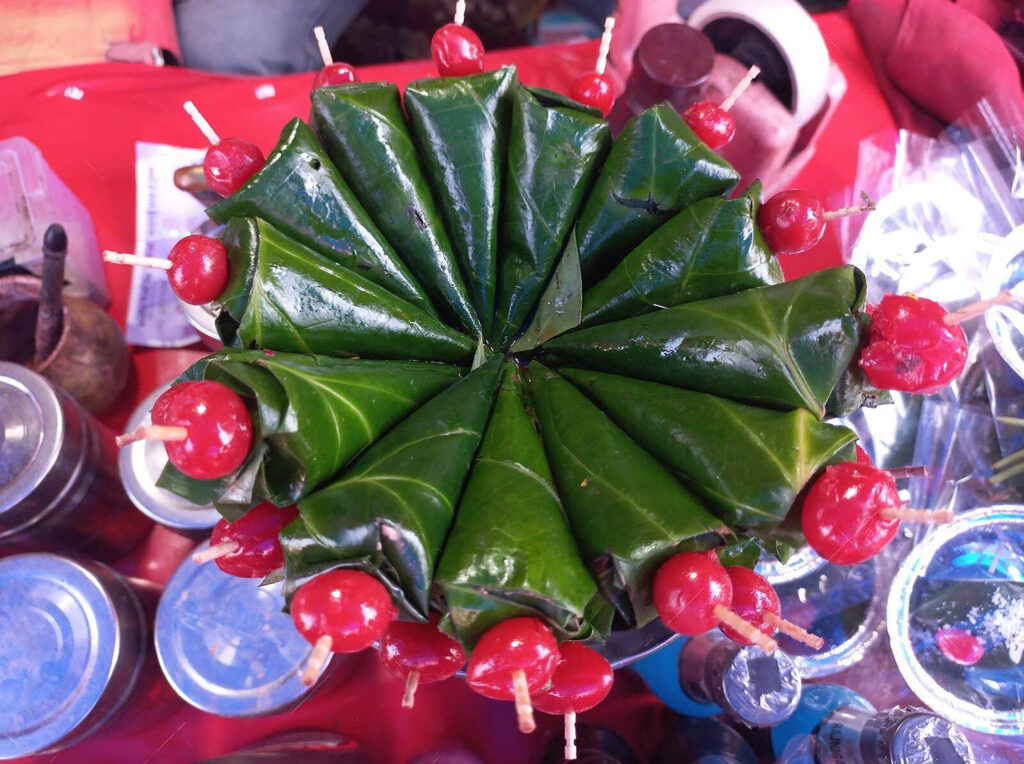
The heart-shaped betel-leaf/Piper betel/paan creeper is cultivated and consumed in many parts of South East Asia. It is also called paan when filled with ingredients and, typically, folded into a triangle called gilouree, ready for chewing pleasure, as a stimulant or digestive, be it saada, meetha, with dry fruit or chocolate. The latest in the series is tandoori (paste) and some paans are ice-cream flavoured.
Betel-leaf mixture/paan masala, spiced/scented chewing tobacco/tambaku, gutka, mukhwas, scented areca/betel-nut/supari and other ingredients of betel-leaf/green paans can contain not only lime-paste/choona but other animal derived substances such as silver foil/varkh, musk/kasturi or some other animal origin fixative in the scents/bahar utilised. And if rose petal jam/gulkhand is used as an ingredient in paan it could contain honey, coral/praval pishti, pearl/moti pishti and varkh.
Betel quid: green paan leaf smeared with choona to which pieces of supari and other ingredients such as kattha and tobacco leaves are added. The paan is then wrapped into a gilouree, varkh could be applied, after which it is chewed.
Catechu/kattha: bark of a tree which imparts a red colour.
Chewing tobacco/khaini: tobacco and choona mixed in the palm of the hand. Ready-mixes (of snuff or snus) are flavoured and scented.
Gutka/gutkha: commercial preparation of supari, powdered tobacco, choona, kattha and other ingredients.
Mainpuri tobacco: mixture of supari, choona and tobacco to which some other ingredients may be added.
Mawa: mixture of supari pieces, tobacco and choona.
Mukhwas/variyali: consists of coloured, aromatic, sugar-coated (possibly covered with shellac) fennel/saunf /ajwain, sesame/til, coriander/dhania, pumpkin and other seeds, betel nut shivers and candied papaya, to which essential oils such as peppermint and rose have been added. It is sometimes used as one of the ingredients of meetha paan, which may have been smeared with choona.
Naswar: mixture of powdered tobacco, choona and indigo (plant).
Paan masala: commercial preparation of processed supari, betel leaf dust, choona, kattha and other ingredients such as menthol, except tobacco.
Qiwam is basically nicotine derived from tobacco, which gives the consumer a “kick”. Spices, herbs, saffron, menthol, incense (containing musk and amber), varkh, etc. are added.
Zarda: broken tobacco leaves boiled in water with choona and spices; then dried and coloured with vegetable dyes. Usually mixed with supari and spices and chewed.
Page last updated on 22/12/25