


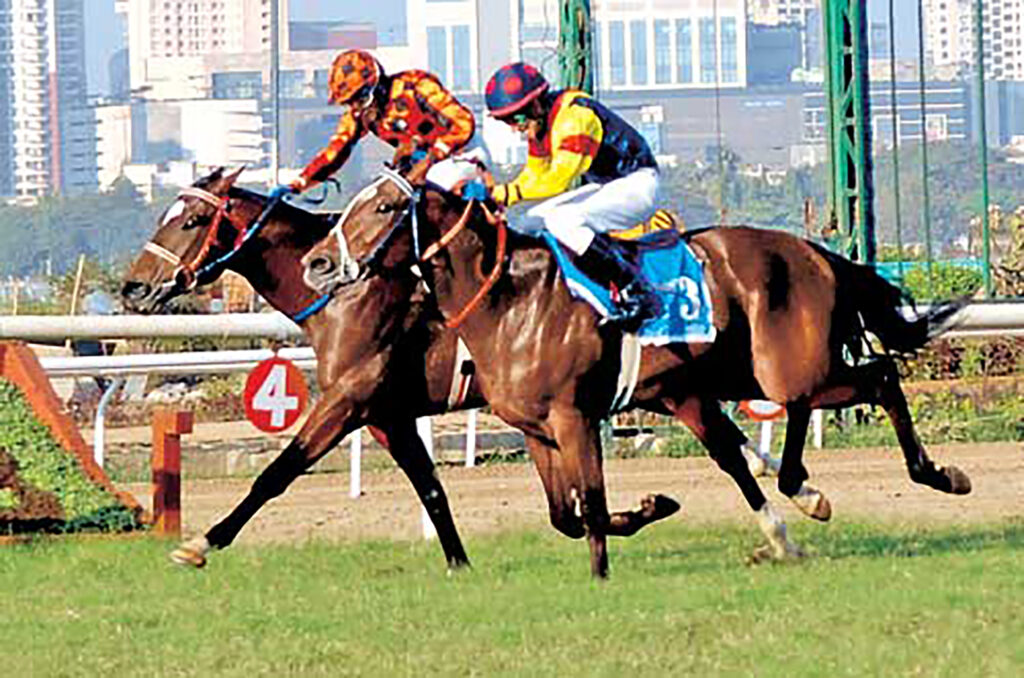
Horse racing is a throwback to the British Raj and its aristocratic club culture. There are several Turf Authorities of India. How some turf clubs have managed to retain the word ‘Royal’ in their names is a mystery. Owning a horse – even a part-ownership of say 10 percent – is popular among the Indian middle-class. Social climbers see race horses as means to boost their standing. Snootiness follows! The horses, mares and foals are but incidental in their game.
Horse Racing
In September 2024 the Tamil Nadu Revenue Department sealed the Madras Race Club in Guindy due to a claim made in 2017 regarding unpaid arrears on revised rent, amounting to Rs 730.86 crore. Two months earlier the department took over the Ooty Racecourse also citing arrears in lease rent.
In March 2025 the Land and Development Office of the Urban Affairs Ministry again slapped Notices on Delhi Race Club and Indian Polo Association, asking them to vacate the prime land on Lok Kalyan Marg, i.e. the Delhi Race Course whose lease for 53.2 acres expired in December 1994 and Jaipur Polo Ground whose lease for 15.2 acres expired in March 1993. When in the Indian Polo Association challenged the Estate Officer’s eviction order the Bench remarked “The little breather we have in NDMC area is also going to go and all of us are going to suffocate and, die.” However, the case was heard by the Patiala House district court. As interim relief was declined, the Centre immediately took possession of the ground on 13 June 2026. The Jaipur Polo Ground is the first among 3 properties to be taken over by the government – the other two being the Delhi Race Club and Delhi Gymkhana Club – for a “larger public purpose”. BWC is pleased that horses will not be exploited for so-called sport or entertainment.
The state government of Punjab hopes to construct a state-or-art Turf Club at Ludhiana for horse (and dog/greyhound) races, despite objections raised by the Animal Welfare Board of India and the state’s Animal Husbandry Department, who were approached by Beauty Without Cruelty. It is nothing short of gambling politics because state governments gain fantastically in taxes. For example, in 2013 the RWITC paid Rs 45 crore for Mahalaxmi Racecourse by way of taxes covering wagering in horse races, rent, property tax, betting tax, entertainment tax, and licence fee.
So-called Sport
5 Myths
OneGreenPlanet has listed 5 myths the horse racing industry spreads:
1. Racing horses are respected athletes.
If horses really were respected athletes would they be stuffing them with drugs in order to perform when it is illegal to do so?
2. The exercise horses get from a race is healthy for them.
There is a big difference between healthy exercise and collapsing after finishing a race.
3. Death is rare in the horse racing industry.
Totally false. Poisoning is quite common. For example, in April 2023 the Police in Nashik began probing a horse’s death since the owner lost 5 animals since 2018.
4. Racing professionals understand horses and their needs very well.
They do not understand the physical limitations of horses and only think of profit.
5. If we didn’t use horses for our own benefit, what purpose would they have?
Horses do not exist for humans. They do not deserve to be exploited for so-called sport or entertainment.
Horse Racing in Singapore runs to the Finish Line
Horse racing which was slowly but surely losing favour in Singapore was scrapped in 2024 (after 181 years of the British having introduced it there, its final race was held in October 2024) in favour of the 300 acres being used to make way for 14,000 new homes.
Stud Farms
India allows only Indian bred race horses to participate. This has given rise to nearly 100 stud farms in different parts of the country with some people owning more than one stud farm.
Drug Abuse
Hormone injections are administered to keep muscles “up”. Performance enhancing drugs that go undetected in human male athletics are compounds like the luteinising hormone which works indirectly stimulating the testes to produce testosterone which in turn bulks up their muscles. This does not work for geldings (castrated race horses) so they tinker with another source of testosterone, the adrenal glands by administering androstanediol and androstadienedione drugs that block aromatase which naturally regulates testosterone levels. The added advantage for the doper is that the levels of these two drugs are undetectable for a couple of days after administration.
On 15 October 2013 in supercession of all previous notifications regarding Medication, Treatment and Anti-doping Control Rules, the Stewards of all the Turf Clubs of India notified new regulations and procedures which can be read here.
That’s not all…
The term gelding is used to denote a castrated horse. (An un-gelded male horse under 5 years is called a colt.) Castration is done so that the horses’ genitals do not interfere with his racing career. The majority of race horses around the world are geldings since they do not develop the temperament of a stallion (horse used for breeding).
Certain Death
While the life span of a thoroughbred (purebred horse) is 20 to 30 years, its racing career is merely 5 to 6 years. If during a race its body capacity is stretched beyond its limit of endurance, it suffers a breakdown – it may bleed from its lungs (is called a bleeder) or more likely its legs shatter under the strain of racing. With a fractured leg, its life is not thought fit to be allowed to continue for one more day and it is destroyed – usually by a bullet in the head. Race horses with broken bones are euthanized because they won’t recover sufficiently well to race again. This happens ever so often: the horse suffers a fractured fetlock (ankle) after stumbling or collapsing due to being overstrained during the course of a race, all because it has been driven, strongly ridden or whipped by the jockey (to please the trainer and owner) to run faster and still faster. At least one horse collapses on the tracks every season and the horse and jockey both get injured. The horse either succumbs to its injuries or is put down. For example, in 2015 Continental suffered a broken leg at the Pune Race Course and was killed on the track itself. Sadly, the focus is not on the welfare of horses, but on winning lakhs of rupees in prize money and trophies of silver and gold.
On 2 November 2025, Animal Liberation Activists and Erase Horseracing India jointly organised a protest at the Pune Race Course because Superluminal, a 4-year-old race horse who fractured his left foreleg during a race, was euthanised on 12 October 2025.
Earlier, in 2023 Victory Chant, another 4-year-old horse was killed due to a fractured right shoulder during a race. In 2024, Deo Volente, a 3-year-old horse who suffered a hip fracture was also killed, as was Golden Neil, a 5-year-old horse who broke both fore fetlock joints mid-race. In short, it is common to euthanise race horses who suffer fractures because it is problematic and long-term to treat them and they cannot participate in a race again.
Young horses stand a better chance of winning, so older ones are made to retire. Retirement involves selling the horse to an amateur riding institute where it would be mercilessly whipped to death; or more likely, to the Haffkine Institute or Serum Institute which produce serums and vaccines for which the poor horses are systematically bled – to death – for blood money. If no buyer is found, the old horse is abandoned to die of starvation. Taking a horse all the way to the Sonepur Cattle Fair (near Patna) when on Kartik Purnima animals are sold is almost out of question. Following the Government ban on the sale of wildlife, each year has seen lesser animals traded, however a few hundred horses were sold (mostly to middlemen) in 2018.
Abroad it’s as bad. After their gainful racing careers are over, race horses that are too old to breed, show jump or do simple trail riding are sent off to “kill auctions” – that is, end up in abattoirs.
However, equine-assisted education seems to be catching on for some retired horses abroad and was even introduced to India 2018. It claims that horse therapy helps in motor skills, mobility and communication of autistic persons and children.
Bad for Horses, Bad for Humans
Horse/Jockey Tack
IPL-Style Horse Races – Disaster
In May 2025 after 8 horses died in Jabalpur, the Madhya Pradesh state government ordered a probe as to how 57 racing horses from Hyderabad had suddenly landed up in Jabalpur. From among the others, 12 were sick of which 6 were in a critical condition having maggot-infested wounds, lung infection, and other ailments, while all were skin and bones obviously malnourished.
Following a complaint by a Jaipur polo player against HithaNet India Pvt Ltd at the Hyderabad Racing Club, regarding the condition of the horses (since 8 had already died there in 2024) 57 horses had been hastily transferred overnight to Jabalpur in trucks. A PIL claimed that they had been sent by the Hyderabad-based Horse Power Sports League and that there were 154 horses with them in Hyderabad whose condition was unknown. The horses had been trained in Hyderabad with the idea to hold races across many cities and move them from betting-style to entertainment-style like IPL-style horse racing league to benefit Indian breed horses as well. A failed idea, although two-format races had been started in late 2023 and discontinued in February 2025.
To quote from a May 2025 Times of India editorial: “Eight racehorses, out of work after the collapse of an alleged racing and better league, have died in Jabalpur, MP. Reports say 57 were transported from Hyderabad – where eight others died at Hyderabad Race Club last year – by road at the height of summer. As blood tests have not confirmed any infection, officials suspect heat, malnutrition and lack of veterinary care killed them. If true, it is criminal and must not go unpunished. Animals are never stakeholders in any human enterprise, be it a racecourse, dairy or zoo. Whether it succeeds or fails, they should be taken care of. Yet too many animal owners in India don’t get this. Dry cows abandoned by dairies, dogs dumped post-pandemic, and now this… Horse racing is not a humane sport. Adolescent horses are put on the track, and peak by the age of 4.5 years, before they attain full skeletal maturity. Injuries are common and still almost impossible to heal. Death can come mid-race via a collapsed heart or bleeding lungs. Horses with broken legs used to be shot, now there are lethal injections. In US, the industry is estimated to kill 6 horses every day.”
Marwari Horses and other Indian breeds
Indigenous breeds of horses that have evolved over centuries exhibit resilience, endurance and agility and therefore they too continue to be exploited in some way or another.
The registered breeds of horses and ponies with the National Bureau of Animal Genetic Resources (ICAR) are Marwari of Rajasthan, Kathiawari of Gujarat, Kuctchhi-Sindhi of Gujarat & Rajasthan, Spiti of Himachal Pradesh, Zanskari of Jammu & Kashmir, Bhutia of Sikkim & Arunachal Pradesh and Manipuri pony. Others are Nokkota of Bihar, Bhagli of Himachal Pradesh, Chummarti of Himachal Pradesh & Tibet, Bhimthadi or Deccani of Maharashtra, Malani of Rajasthan and Sikang of Sikkim.
The Bikaner branch of the National Research Centre on Equines has produced 2 Marwari and 2 Zanskari foals via surrogacy. An embryo transfer technology is sold for Rs 4 lakh. The centre has a DNA chip to scan genomes and track ancestry/disease risks. It is working to expand horse semen availability around the country and sells 400 doses with proven DNA parentage annually, the market rate of a single dose varying from Rs 11 thousand to 7 lakh.
The Indian half-bred horse mainly used by the Indian Army and Police, is a cross between Throughbred stallions and different mares. Whereas the Tattoo is a cross between riding horses and pack or draught work breeds of India.
In March 2019 the Indigenous Horse Owners Association (IHOA) presented the Marwari Horse Show’s fourth edition at Pune Race Course. The IHOA showcases the prowess in racing, endurance and equestrian events of these horses. They are replenishing and rebuilding their stock because they wish to dispel wrong notions about them particularly that they can not race like thoroughbreds.
In their fifth edition in 2020 the IHOA declared that efforts were underway to revive the Bhimthadi breed of horses which once served the Maratha army but were now on the verge of extinction.
The IHOA had till the end of 2024 held eight editions.
Illegal Horse Races in Rural Punjab
When in April 2025, BWC got to know that horse races, similar to illegal bullock-cart races, were planned to be illegally held at Village Mattran District SAS Nagar, Mohali (near Aerocity), Punjab, we wrote to the Chief Secretary, Animal Husbandry Director, District Collector and Police. We stated that they attract the provisions of the Prevention of Cruelty to Animals Act 1960 and clearly violate the Rules like the Transportation of Animal Rules, Performing Animal Rules, Motor Vehicle Rules, etc. Moreover, the weather was very hot and as it was getting hotter each day it could result in serious consequences for the poor horses. We therefore requested them to ensure that not a single horse race is held.
Decreasing Numbers
As per the last Livestock Census of 2019, there were a total of 3.4 lakh horses only, having gone down as much as 45,2% over the previous Census. Unsurprising because of their decreasing utility as working animals, but why exploit them for entertainment?
Pushkar Fair
Horses are not only traded at the annual Pushkar Fair near Ajmer in Rajasthan but horse races and “dances” are held. The horses are systematically hit on their legs by a man so jump up and awkwardly move on their hind legs while another man holds the reins tight in an effort to control and guide the horse into so-called dancing, while drummers walk in a circle around them.
In 2025 there was an increase in the number of Marwari and Kathiawadi horses sold at Pushkar because in rural areas they continue to be a mode of transportation. Horse-carts and camel-carts are used for transporting food grain to the mandi.
Malkangiri Ponies
These sturdy horses have been around for more than a century and have adapted to the terrain, withstood drought and shortage of food. They are used for transportation of farm produce from fields to homes to markets as well as construction materials to hilltop villages. Without formal training in horse-riding young tribal boys begin riding horses before they are even 10 years old. However with the construction on roads in the area, many horses that were abandoned died during the rains.
In January 2023 the district administration of Swabhiman Anchal (Odisha) conducted a rural derby competition using Malkangiri Ponies as part of the Malabanta Mahotsav to coincide with the Hockey World Cup held in Bhubaneswar.
Rewal Chaal
Horses born with the natural ability to perform Rewal are called Ambling Horses or Amblers and all the three Western Indian breeds (Sindhi, Kathiawari and Marwari) are Ambling Horses. It is said that packs of Sindhi horses are still seen in the wild.
Sindhi horses (from north-west India, adjoining Pakistan) participate in Rewal Chaal or lateral ambling gait which is cruelly taught to be performed fast. Tracts and breeders are mainly found in Surat, Navsari & Kutch of Gujarat, and Jaisalmer & Barmer districts in Rajasthan.
Formal training starts at 2 years but the actual training begins when the foal is born – frequent touching ensures it does not hide behind its mother. Then when 4 months old the foal is put on halter and taught to follow its handler. During this time it is also taught to rear up or lift its legs on cue. After one and a half years horsecloth, saddle, girth and bridle are utilised and the horse is led for walks up to half a kilometre. By the time the horse is 2 years old it gets bridle trained to move forward and backward. The horse is continuously whipped into submission to run in circles with the trainer controlling it with a long thick rope attached to the reins. That’s when a rider mounts it, and after it stops trying to dislodge him, the horse is taught to trot, canter and gallop.
The Rewal or Varra is not a movement, it is a gait and the trainer has to somehow bring up this inborn trait so that it gets firmly ingrained in the horse.
Rewal (also known as Rewal/Rehwal/Indian Shuffle/Lateral Amble) is a 4 beat gait where each leg of the horse touches the ground separately. Correctly performed, the so-called well trained horse can move at the rate of 45 kmh.
In the Rewal gait, the movements are left hind leg followed by left foreleg, and then right hind leg followed by right foreleg, or the other way round.
The backbone of the horse remains still straight and steady even when it is running very fast because almost no vertical movement occurs. A rider and horse can therefore cover distances of up to 60-75 kms at one stretch.
From October to February about 15 to 20 Rewal Chaal races are organised, including national-level competitions with around 50 participants from Gujarat, Madhya Pradesh, Uttar Pradesh, Bihar and Maharashtra, with winning prizes ranging from Rs 81,000 to Rs 61,000 to Rs 41,000 along with gold and silver medals.
Chetak Festival
The 350-year old annual Sarangkheda Horse Fair metamorphosed into a month-long Chetak Festival, one of the oldest and largest. Along the Tapi River in Sarangkheda village of Nandurbad District in Maharashtra, the site is of 50 acres. Over 2,000 horses arrive from 14 states to the Chetak Festival. Not only are they sold and bought, but Equine events like Ball in Bucket, Pole Bending, Barrel Race, Show Jumping, Hat Race, Tent Pegging, Horse Dancing, Horse Dressage, Horse Buggy Ride, Rewal Chaal Races are held. Marwari, Kathiyawari and Nukra (not a breed, but an Albino, born white) horses are showcased. Cultural programmes and competitions are also a part of the festival.
Nukra
The Nukra horse is not a breed, but an Albino variant of the Marwari horse. These beautiful white horses have been specially bred for 50+ years. This has led to severe in-breeding, weakening of their immune systems, and increasing susceptibility to life-threatening conditions such as skin/genital cancer, eye-tumors, and sarcoids (an inflammatory disease with formation of granulomas in the lungs, lymph nodes, and other organs) in foals younger than 4 years. The reason for this acute on-going suffering is lack of melanin, the natural pigment that shields skin from sun damage, thus making them defenseless under the sun.
BWC feels if there is no demand for these white horses during wedding processions and other events, they would not be specially bred…
Kashipur Horse Market
In 2025 Uttarakhand’s 170-year-old Kashipur Horse Market, a part of the Chaiti Fair in Udham Singh Nagar’s Kashipur held during Navratras was shut down. The owners of the 2 acre land on which this annual Nakhasa Bazaar was held, did not want to continue hosting it. Horses from all over India like Marwari, Sindhi, Kathiawadi, Spiti and Manipuri used to be brought there for sale.
Equines of Matheran
In October 2024 a resident of Matheran approached the National Green Tribunal (NGT) to impose restrictions on the number of horses (mostly Kathiawari breed) used for tourism. It pointed that that the 460 horses and 200 ponies produce over 3 tonnes of dung daily which not only harms the eco-sensitive zone (ESZ was declared by Government of India in 2003) but results in air water and land pollution adversely affecting human health.
In April 2025 the Maharashtra Pollution Control Board submitted a detailed interim report to the NGT analysing and highlighting the increase in air, water and soil pollution from horse dung in Matheran.
Feral and Wild Horses
Dibru Saikhowa National Park in Assam is home to a small population of feral horses. They could be descendants of the abandoned horses used by the Allied Forces against the Japanese in World War II. Or, they could be descendants of cart horses found in the area in the 1940s. Although some say they are descendants of China’s Przewalski’s horses, considered a wild horse species. Today they face threats from smuggling and since they are not considered wild life no protection is given to them under the Wild Life Act.
Point Calimere in Tamil Nadu has a population of wild horses whose ancestors are also considered wild.
No Real Love
Horse racing is based on power, prestige and prosperity with glitz, glamour and fillies on the side. The end justifies the means – as long as one gets away scot-free. For example, in September 2025, 5 race horses (4 of the 5 had taken part in the Indian Derby) kept in the race course stables were deliberated injured on their legs resulting in swelling so that they would not be fit enough to race.
Page last updated on 17/06/26