


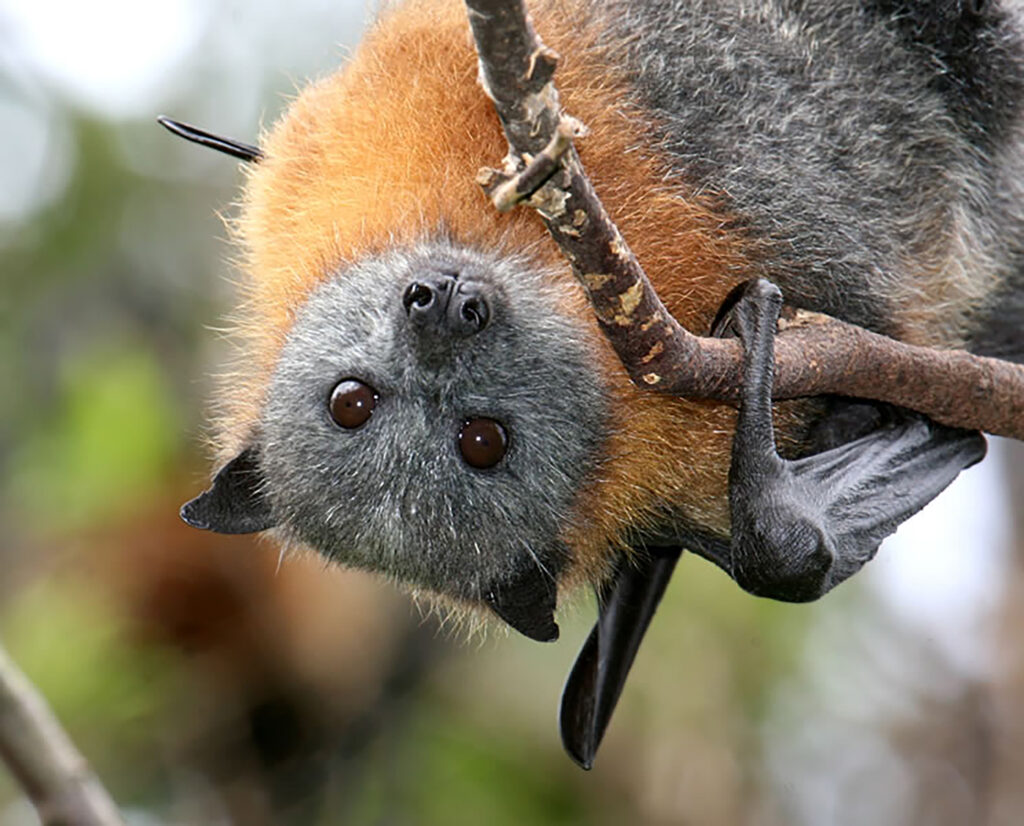
Flying foxes are hunted and eaten on special occasions in the Andaman & Nicobar Islands. These bats are consequently classified as vulnerable under the International Union for Conservation of Nature (IUCN)’s Red List.
Bats
India has over 100 species of bats including the flying fox, considered the largest in the world. They are found high in the Himalayas, to the deserts of the North West, to the tropical forests of the East and South. Old caves and tunnels are their most favoured locations, followed by dark niches and big crevices of heritage sites, tombs and forts. Bats are also found in hollows of old trees usually adjoining temples. They become active at sunset when they emerge from their roosts, drink water and then eat ripe fruits they can find such as figs, bananas and mangos, seeds and pollen from flowers. Sapota/chikoo and areca/supari trees attract them.
Superstitions
Bats and owls are clubbed together in Indian superstitions. A bat or owl flying over a house is said to be a harbinger of death. The sacrifice of nocturnal owls and bats on auspicious occasions are recommended by tantriks.
Hunting by Tribe
Collisions with Wind Turbines
To effectively tackle the bird/animal hits at airports the National Wildlife Hazard Management Committee was convened in June 2025 at the DGCA HQs in Delhi. The IGI Airport Delhi officials said bats had emerged as a major threat; and “techniques like black light trap, pole pigeons, night vision binoculars, bat detection devices, Avian Defenders and deploying a team of biologists were being done to mitigate their presence”.
Killing by Zoologists
Bats are Guests
People of Tabakad Honnalli village in Kalghatagi taluk, Hubballi in Karnataka perform a puja every month at a small temple below the tamarind trees on which bats roost. Decades back bats moved out of this village, after which it suffered severe drought which got attributed to their desertion. The villagers then performed a grand puja, offered sarees, beat drums, blew trumpets and other musical instruments and succeeded in inviting the bats back from Hindasageri village. Since then thousands of bats hang upside down on trees at Tabakad Honnalli village throughout the day where they know they are revered. But at dusk they fly out, nearly 100 kms away in search of guavas, bananas and other fruits. They return at the crack of dawn and wake the villagers with their screeching and fluttering noises of their wings.
Page last updated on 20/08/25