


Animals in Processions
Misuse of work animals is fairly common and as animal allies we should at least, if within our power, stop animals being utilised in processions.
Also, several incidents have proved that using animals in processions has seriously back-fired on humans. One of these being in February 2016 when during the Bhagavathi temple loud music-filled festival procession in Pallakad (Kerala), a caparisoned elephant ran amok, angrily destroying vehicle after vehicle. It took the 2 mahouts sitting on top of the elephants several hours to bring it under control.
No wonder animals were prohibited (on paper only as it turned out) during the Kumbh shahi processions at the Nashik mela in August 2015. The reason given by the officials was that in view of the number of pilgrims that turned up in the city on the Shahi Snan days it was practically impossible to also accommodate the animals into the narrow shahi marg which would be jam packed with people. However, some elephants, horses and camels were used by the mahants and sadhus saying that it was their age-old tradition and cited that processions taken out in Orissa for the Jagannath Yatra and the Allahabad Kumbh had 20 elephants.
In 2022 animal rights activists opposed the use of elephants that would be taking part in the Dassera celebrations in Mysuru. The elephant has to carry a Golden Howdah and walk on the tarmac for 2 hours covering 9.4 kms from Amba Vilas Palace to Bannimantap during the Jamboo Savari. The Howdah itself weighs 750 kgs while the weight of Gaddige, Mahout and the ornamental caparison adds another 250-300 kgs. They suggested that a much lighter replica of the Golden Howdah be taken in a chariot drawn by an elephant.
In June 2026 the Union Ministry of Tourism sent an Advisory to Chief Secretaries of States and UTs as well as their Tourism Secretaries, on adherence to animal welfare standards at tourist destinations for promotion of responsible and sustainable tourism. Awareness and Compliance, Welfare of Working Animals and Destination Management were covered in relation to the Prevention of Cruelty to Animals Act, 1960 and the Wildlife (Protection) Act, 1972.
Although we have come a long way mainly with welfare measures, much is desired. It is the right of each and every animal and bird, whatever the species, not to be misused by humans.
Religious
Animals such as horses, ponies, camels and elephants traditionally feature in religious functions. Processions involving such animals require Police permission. Crackers are burst and blaring music is played all along the route which quite often scares the animals and they go berserk thus injuring people. For example, in Pune during a temple procession organised on the occasion of Rath Saptami 2009 by the Shree Balaji Mandir Trust, a 5-year old girl died after being kicked by a horse on her head following crackers being burst. The Pune Police therefore temporarily banned animals (horses, camels, elephants) in processions. Then in response to frequent requests made to the Pune Police by the Sarva Jeev Mangal Pratishthan and Beauty Without Cruelty, they began issuing orders banning the use of animals (camels, elephants, horses, ponies and cattle) in processions and rallies. The first such order was passed for Shivaji Maharaj Jayanti celebrated on 19 March 2014. However, some months later in November 2014 an old gentleman while walking on the road was knocked down by a horse that gave joy-rides. He suffered grave head injuries requiring six-hour surgery, was in a coma, and eventually died after a fortnight.
Some times bulls are also used in religious processions. For example, to celebrate the Diksha of 11 Jains, bullocks were found dragging overloaded (with 15-20 persons) carts. The procession was stopped by the SPCA and 4 bullock cart owners’ persons were booked by the Gamdevi police in Mumbai. The other participating bulls were also found to be in a poor condition.
In April 2013 animal activists objected to the Vadundhra Jain Temple Ghaziabad (Delhi) using horses, bulls and elephants for Mahavir Jayanti celebrations. The highest bidder was to ride on the elephant during the procession. Their previous year’s procession saw one of the two elephants being killed after being hit by a truck on the NOIDA expressway, whilst the other was severely injured and had to be shifted to a sanctuary at Agra. Despite this, in 2015 elephants, camels and horses were scheduled to give joy-rides during an inauguration organised by a builder where the chief guest was a Jain muni and the community were invited. Luckily due to the efforts of animal activists, political pressure was used to stop the use of animals on the day itself and the animals were sent back in the afternoon.
In contrast, in January 2013 for the first time the Ulema (religious heads/scholars) opposed the use of bullock carts in the Eid-E-Milad procession at Mumbai citing cruelty to bulls.
The season for temple festivals (vela/pooram) covers March, April and May (summer – the hottest months of the year) and processions with at least 3 and up to 15 temple elephants participating is a vital part of these celebrations. A growing trend is for churches and mosques to also organise elephant processions. A huge strain for temple elephants – they lose nearly 300 kgs in a single festive season.
No one, especially in Kerala, adheres to the rule that an elephant can not be made to feature in a ceremony for more than three hours at a stretch. They are not only made to walk long distances on hot, concrete roads, again in violation of rules, but they aren’t even given sufficient water to drink – an elephant needs about 230 litres of water every day.
For Ashura 2024 a day of commemoration in Islam, an innocent horse was repeatedly slashed with a knife and was paraded on the roads of Mumbai. It was cruel and ghastly beyond words as seen in a video, but strangely the Dongri police informed representatives of an organization working for animals that it was painted, not lacerated.
Political
In January 2025 the order granted by the Addl Chief Wild Life Warden of Kolhapur circle to transport an elephant stated “Permission granted under the order is only to transport the elephant and not for procession and palanquin events” despite which the animal was used illegally in a procession organised for the Bhor MLA’s win in the Assembly elections.
Attracting Tourists
In 2009, aiming to phase-out working elephants (only females because males get violent when they are on heat or musth) made to take tourists up to Amber Fort, the Rajasthan state government began looking after them. Soon after, they built an elephant village called Haathi Gaon to house them and their mahouts, and attract tourists too which resulted in a lot of criticism of how the elephants continued to be handled with the cruel ankush and made to work long hours. The walk up the hill is steep and takes an elephant 15 to 20 minutes, half the time it would take a human to reach the top, whereas a jeep ride would be much less. However, it is alarming that although old and sick elephants have died, by 2013 the herd had increased by about 24% – this indicates young ones were being surreptitiously added and there is no commitment to phase-out these elephants.
BWC was shocked to know that a Russian photographer was allowed to paint pink a 67-year-old elephant named Chanchal from Hathi Goan. The stress could very well have contributed to her death from cardiac failure a couple of months later in February 2026. We asked the Dy CM of Rajasthan to take immediate strict action against those responsible for permitting it and said that the cruel act would probably stop tourists from visiting Jaipur, the state’s pink city.
In October 2024 a resident of Matheran approached the National Green Tribunal (NGT) to impose restrictions on the number of horses used for tourism. It pointed that that the 460 horses and 200 ponies produce over 3 tonnes of dung daily which not only harms the eco-sensitive zone (ESZ was declared by Government of India in 2003) but results in air water and land pollution adversely affecting human health.
Then in December 2024, a health camp organised for the Matheran ponies by animal welfare groups detected cruel spiked bits in their mouths (used to cause pain in order to control them), forcing sick & injured animals to work, malnutrition, harsh and unsanitary living conditions, as well as inadequate veterinary care.
However, during the Pandemic the horses of Matheran as also horses operating at other hill stations such as 297 horses at Mahableshwar-Panchgani that were giving horse-cart joy-rides had stopped functioning due to lack of tourists. Then in 2026 horse and buggy operators were found to be misleading tourists citing a false vehicle-ban, thus forcing them to hire their rides.
Mascots and Alms
Elephants are used illegally for begging and giving rides too. It is a business for the owners/mahouts. Many years ago, a leading Bank (for reasons best known to its manager) gave a business loan to a man to buy an elephant. Not long after, when the man was unable to earn enough to feed the elephant or himself leave along pay the interest to the Bank, he abandoned the animal by tying it at the entrance of the Bank. Countless captive elephants have suffered neglect in the form of insufficient food and medical aid. This has in turn resulted in elephants going into an uncontrollable mad rage. For example, in November 2011, at Burdwan (West Bengal), an elephant picked up, flung and trampled to death a 7-year old boy after having taken him for a joy-ride.
In 2013 elephants were banned from plying the streets of Greater Mumbai, Navi Mumbai and Thane, so these majestic animals which were in a pathetic condition – underfed and dehydrated with sore feet due to the hot concrete roads they walked on – are no longer seen begging for alms, and rarely used in processions or giving rides in the midst of heavy traffic. BWC feels that if you must give some thing for such elephants, then feed them, do not give money to the mahout because it encourages them to exploit elephants by making them beg. Meanwhile in 2012 local animal activists began trying to get the state government to provide a rescue centre but it hasn’t materialised.
Horses without Carriages
To commemorate Horses Without Carriages International Day (first Saturday of December 2012) BWC sent out a Hinsa vs. Ahinsa number highlighting the fact that despite horses suffering no end, horse-drawn carriages continued to be used as tourist attractions in Mumbai. It was also pointed out that human safety was at stake since the victorias were not designed or made by coachbuilders and wheelwrights and were lacking in balance and brakes.
Then in April 2016 the Supreme Court dismissed a special leave petition challenging the Bombay HC order and directed the owners and drivers of the victorias to approach the HC again to review the government’s rehabilitation plan for them since becoming hawkers was unacceptable.
Sound and Fury
The loud noise of bursting fire-crackers at Diwali and other festivals, on auspicious occasions like weddings, during religious processions, political campaigns, and even when India wins a cricket match, causes fear and panic in domestic animals and birds, particularly dogs.
At a wedding in Meerut an elephant (of the 15 brought to welcome the baraatis) ran berserk when crackers were bust and gunshots fired as part of the celebrations. The elephant was chased for 15 hours by over 200 persons during which time he smashed vehicles, blocked roads and finally went into a sugarcane field where he was tranquilised and captured.
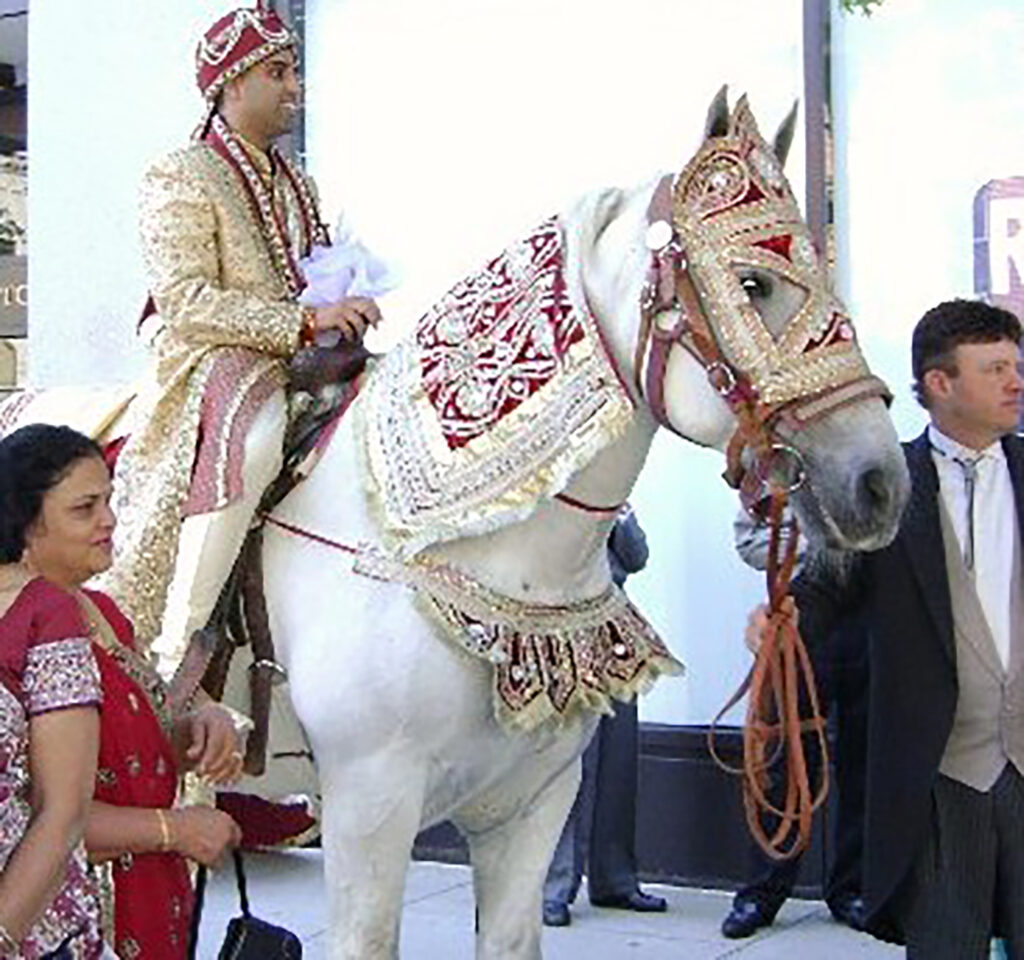
Pure white mares usually used for weddings are known to be blind. They are housed in pathetic conditions and more often than not need to walk several kilometres to the residence of the groom. There the horse is covered in finery and a heavy throne-saddle is placed on its back on which the bridegroom and another sit. The loud band and boisterous people around are absolutely stressful for the animal that therefore needs to be tightly held by the bit and steered along the route slowly to the bride’s place. A bit is a metal rod or mouthpiece that is put on the interdental space of a horse’s mouth and is attached to the bridle & reins to control the movements of the horse. There are different kinds of bits like snaffle, curb, gag and can even have spikes on them. In fact, an iron chain could be fitted into the horse’s mouth making its gums bleed and fire-crackers and fire-lanterns used which make it scared.
Such pure white horses are known as Nukra but Nukra is not the name of a breed of horse. They are an Albino variant of the Marwari horses that have been specially bred for 50+ years. This has led to severe in-breeding, weakening of their immune systems, and increasing susceptibility to life-threatening conditions such as skin/genital cancer, eye-tumors, and sarcoids (an inflammatory disease with formation of granulomas in the lungs, lymph nodes, and other organs) in foals younger than 4 years. The reason for this acute on-going suffering is lack of melanin, the natural pigment that shields skin from sun damage, thus making them defenseless under the sun. BWC feels if there is no demand for these white horses during wedding processions and other events, they would not be specially bred.
Such pure white horses are known as Nukra, but Nukra is not the name of a breed. They are an Albino variant of the Marwari horses that have been specially bred for 50+ years. This has led to severe in-breeding, weakening of their immune systems, and increasing susceptibility to life-threatening conditions such as skin/genital cancer, eye-tumors, and sarcoids (an inflammatory disease with formation of granulomas in the lungs, lymph nodes, and other organs) in foals younger than 4 years. The reason for this acute on-going suffering is lack of melanin, the natural pigment that shields skin from sun damage, thus making them defenseless under the sun. BWC feels if there is no demand for these white horses during wedding processions and other events, they would not be specially bred.
At Ghaziabad in January 2015, a horse carrying the bridegroom to his marriage ceremony was electrocuted by a power cable hanging loose from a pole and died almost immediately. The owner of the horse was walking in front, leading it. The groom immediately jumped off thus saving himself too.
In April 2015 a mare called Payal had been booked to carry a groom in a wedding procession at Mumbai, but while being taken there she got frightened by a garbage truck horn. She threw off her jockey-caretaker who fractured his leg and looked on helplessly while she bolted… she entered the toll naka and ran alongside the cars almost the entire length of the Bandra Worli Sea Link… eliciting smiles, chaos and a slowdown of cars. Eventually, some Israeli tourists who knew how to handle horses got off their taxi and reined her in. It then came to light that in a few months ago the owner had bought the 4-year old ghodi costing Rs 1 lakh, but on a down payment of Rs 25,000/- from a rural fair in Solapur. He said that she could dance, had also acted in the TV serial Maharana Pratap and appeared in newspaper advertisements.
Luckily, there is a growing number of bridegrooms who out of kindness and sympathy for horses have opted out of riding horses. In other words: “just baraat, no ghodi”.
Page last updated on 03/07/26