


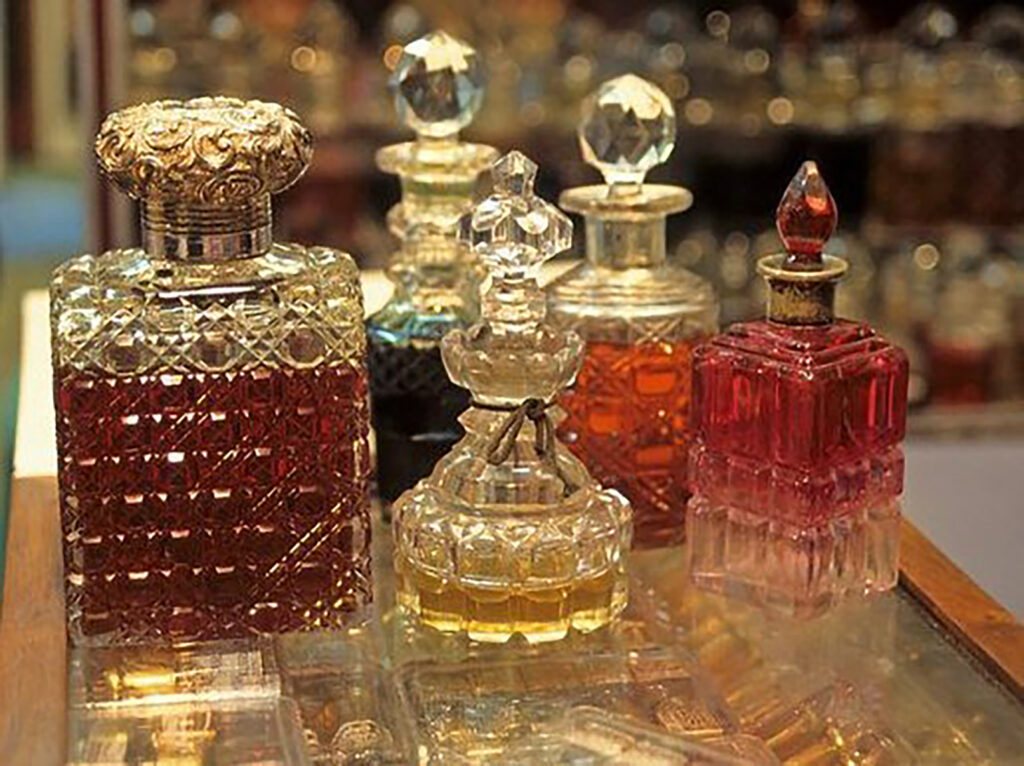
Essential oils are fragrant materials that have been extracted through distillation in the form of an oily liquid.Steam is passed through plant material causing the formation of essential oil which turns into a gas which is passed through tubes, cooled and liquefied.
Perfumes
Perfume is a substance that emits and diffuses an aroma. Commonly used synonyms are fragrance and scent. Whereas, incense is aromatic material like agarbattis which release fragrant smoke when burned.
Essential oils, absolutes, tinctures and attars, in varying strengths, are a part and parcel of the perfume industry. Pure perfume/parfum contains the highest concentration of oils in a fragrance, followed by eau de parfum, and then eau de toilette.
Oils
Tinctures
Blending and Aging
Aroma Compounds/Synthetic Substances
Cheap so fast becoming popular synthetic ones (some call them French ittar) are called iceberg, rose, dove, lavender and sandalwood. Some perfumers make agarbattis and creamy organic soaps to match the perfumes they sell.
Attars
Attar/itr or fragrant oil concentrates are traditionally made pure natural extracts that could be of animal origin, such as musk. They never contain alcohol or chemicals. It is said that people, particularly foreigners, are attracted to organic attar as compared with cheap synthetic perfumes ironically sold by the same people. Synthetic versions are made using chemical solvents like dioctyl-phthalate and diethyl-phthalate.
Flower petals such as those of jasmine/chameli, screw pine/kewra and rose/gulab are collected at sunrise when they are dewy and fragrant, and transported to a distillery where they are crushed into a paste that is either burnt or boiled. The condensed vapours are what form the essence of any attar, and subsequent distillations and mixtures produce compounds of various scents. The first distillation is prized and the most expensive.
Digahas/master distillers manufacture attars by the deg/still and bhapka/receiver system which is a hydro distillation process. When the desired concentration of the attar is attained, it is poured into a kuppi or leather bottle for sedimentation and removal of moisture. It is considered absolutely essential to store the attar in a kuppi because moisture from the attar must be removed and this is effectively achieved due to the semi-permeability of the leather.
Interestingly, there are two kinds of basic attars, floral (rose, bela, etc.) and herbal (sugandh kokila mantra, cardamom, clove, etc) used in this hydro-distillation process that is fired through dung cakes or wood utilising copper vessels, bamboo pipes, clay seals and steam distillation to extract the essence – however, sandalwood oil is the base. The burnt wood is consumed by the agarbatti industry.
One can not think of attars without thinking of the Moghul period and the city of Kannauj which today manufactures about 8,000-10,000 barrels, each containing 200 litres of perfume. This city located near the confluence of the Ganga and Kali rivers in Uttar Pradesh, has been famous for perfumes since the days of Harshavardhana who ruled North India between 606 and 647 BC. To this day, 75 to 80% of attars produced, especially gulab, kewra, mehndi, hina, shamama, mitti and marigold, are mainly used as ingredients in paan masalas, gutka, and to a lesser extent in tobacco. Scented chewing tobacco and betel nut/supari contain scents/bahar which could contain animal substances. Gulab and kewra are also used in traditional mithai to impart fragrance and flavour.
The attar industry was deprived of sufficient and reasonably priced sandalwood oil because of the all-India ban imposed on sandalwood after the notorious dacoit Veerapan decimated sandalwood trees from the forests of South India. (Incidentally, in the mid-1970s BWC had complained to the Karnataka Forest Department about the bandit stealing and smuggling sandalwood, but unfortunately action taken was not strong enough to nip his activities in the bud, as a result of which he and his gang became bolder and expanded their illegal activities to killing elephants for ivory. Kidnapping and killing of forest officials and rivals followed.)
In 2014 pure sandalwood oil (50% is extracted from the roots of the trees) cost Rs 90,000/- a litre. Decades back it had been partially substituted by liquid paraffin in attar manufacture. However, the attar-makers are hopeful that sandalwood cultivation in their region will help them although not in the immediate future… after years of trial and error, sandalwood saplings began growing on the Fragrance & Flavour Development Centre (FFDC) campus, in addition to which hundreds were also nurtured by farmers of the area. Harvest is expected to begin after 2025. In 1991, with support from the United Nations Development Programme and United Nations Industrial Development Organization, the FFDC was set up by the Government of India and the Uttar Pradesh state government under the Ministry of Micro, Small and Medium Enterprises. The FFDC serves as an interface between essential oil, fragrance & flavour industry and research & development institutions in the fields of agro- and chemical-technology. They frequently organise workshops, and with support from the Forest Research Institute, Dehra Dun, the FFDC runs aroma technology courses.
Mohammed Ali Road in Mumbai is also lined with attarwallas. Their businesses began and flourished during the reign of the Mughals, but they continue to do business in Lucknow, Delhi, Hyderabad and parts of Rajasthan.
However, attar that was popular all over the world is no longer so much in demand mainly due to the onslaught of inexpensive alcohol-based fragrances and deodorants. High manufacturing costs and selling prices is responsible, for example in 2025 a 100 ml of genuine rose attar cost about Rs 1,500/-, whereas a Rs 200/- version was readily available in the market. By 2025 perfumers in Kannauj had begun experimenting with spray-based attars, using alcohol as a solvent. Moreover, Kannauj’s Bara Bazar shelves were found to contain re-creations of international brands such as Armani, Dior and Channel.
Attar is used mainly by Muslims for ritual purposes during festivals. For example, a scent called majma or majumua is sold for Idd. Bohras burn bakhur. Sudani Muslims use heavy attar called mahalad and Arabs use nakhla, manufactured from crushed sea-shells, in their ceremonies.
In winter shamaama attar made of wood from Kannauj is sold for combating colds. Hina attar, containing musk/kasturi is illegal (the musk deer is protected under the Wild Life Protection Act) nevertheless, is sold as an aphrodisiac too. However these days, oodh attar made from the bark of an Assamese tree is recommended as an aphrodisiac. It is one of the most expensive and sells for Rs 20,000/- a tola.
Common materials used for making attar are:
The base materials of attars consist of sandalwood oil (obtained from South India), Di-Octyl Phthalate (DOP) and maybe liquid paraffin. Mitti attar is produced by distillation of baked earth over the base material. It supposedly cures tobacco addicts and is an antidote to food cravings.
Flowers such as gulab (from Aligarh, UP and Palampur, HP), kewra (from Ganjam, Orissa), bela, mehndi, kadamb, chameli, maulshri, marigold (all these flowers are locally grown at Kannauj, UP) and saffron (from J & K).
Spices and herbs such as oakmoss, sugandh mantri, laurel berry, juniper berry, cypriol, Indian valerian, jatamansi, hedychium spicatum, daru haldi, sugandha bala, sugandha kokila, kulanjan, javitri/jaiphal, cardamom and clove.
Despite being banned, musk and ambergris are common ingredients of animal origin, used in attars.
Certain attars contain a combination of materials. For example, hina, musk-hina, shamama, shamam-tul-amber and musk-amber.
Ingredients/Sources used in Perfumery: Plant/Veg origin
Lactones: “Milk” perfumes usually do not contain actual milk but are made from lactones originating mainly from peaches, apricots, figs and coconuts. (More than 100 lactones are used as flavour ingredients. However, vegans need not utilise something that smells like dairy even if it doesn’t contain it.)
Woods: sandalwood, rosewood, agarwood, birch, cedar, juniper and pine. Camphor/kapoor is from the camphor tree and is incense.
Ingredients/Sources used in Perfumery: Animal/Non-Veg origin
Ambergris/amber: a solid waxy substance produced in the intestines of sperm whales and thrown up by them. It could be black, grey, different shades of brown, or yellow. Squid beaks (smooth and shiny) are always found in ambergris because it is formed to protect the whale from sharp objects which need to be expelled. (Ambergris-laced sugar fetches a high price and is a marketing gimmick.) It is used in aphrodisiacs also.
Civet/gandhamarjara: civet cats are bred in captivity, imprisoned lifelong in narrow cages, frequently teased and made to undergo hundreds of painful scrapings of their glands to produce the extract.
In the 1970s every week as many as 108 civet cats were trapped in Kedappa and killed for the civet to be used in the Tirumala Venkateswara temple poojas at Tirupati.
When in 2011 the temple proposed to breed civet cats in the Sri Venkateswara Zoological Park for extraction of their secretions, BWC wrote to the Central Zoo Authority (CZA) not to grant permission but undertake a drive to stop the prevalent use of gandhamarjara in temples because it was illegal. However, no assurance was received from the CZA who said they’d written to the curator of the zoo who did not reply!
Earlier two unsuccessful animal farms had been set up by the Central Council for Research in Ayurveda & Siddha (CCRAS). One of them, run by The Indian Institute of Panchakarma in Trichur District of Kerala, which experimented breeding civet cats in captivity so that civet could be collected from the animals for use in Ayurvedic medicines. The civets were kept in small cages having rough wooden sticks in the centre on which the animals were made to rub their pouches. Leave alone breeding, the pairs died, and they were on the look out for replacements.
The Asian palm civet or toddy cat in Kerala is marapatti. However, it is called gandhabilav and mushkabilav in Hindi. In Assam it is gendera or johamol, in Marathi jowadi manjur, and in Kannada punagin bek. A variety of fragrant rice in Bengal is known as govindabhog (offered to Lord Krishna) and since the civet cat’s gland has a similar smell, the animal is gandho gokul.
Incidentally, civet cats as well as with other wild life are utilised for street performances in villages of Bihar. And, in Assam they (johamol) are considered a delicacy.
Deer musk/kasturi: musk obtained from the male has led to the wholesale slaughter and near extinction of the Himalayan Musk deer. Musk deer farming is unsuccessful.
In May 2014 the Chief Secretary of Odisha wrote to the Government of India informing them of the shortage of kasturi at the Jagannath temple at Puri and seeking their assistance in procuring it for the Navakalebara festival which will be held next in 2015. On knowing this, BWC requested the Secretary of the Ministry of Environment & Forests to investigate the matter on priority and intervene to stop its import and use. Simultaneously, the temple authorities were made aware that kasturi was obtained by killing deer and therefore they should reconsider its use.
Ironically, many Jain temples also utilise kasturi illegally.
Mother-of-Pearl: in order to be innovative, an international brand has infused its eau de toilette (a dilute form of perfume) with specks of mother-of-pearl.
Allergies
Incense sticks/Agarbattis/Dhoop
Basically, there are two categories of incense: masala agarbattis like durbar and champa are made by blending several solid scented ingredients along with an adhesive into a paste and rolling it on a bamboo stick, whereas dhoop may lack the core stick and contain a higher percentage of sandalwood. Charcoal agarbattis are made by dipping unscented “blank” sticks (smeared with adhesive/binding resin/gum) in a mixture of perfume and essential oils. The adhesive utilised in their making is usually of animal origin. In addition to this, the perfume could also contain a fixative of animal origin. It is not commonly known or easily admitted by manufacturers that a fixative called nakhla/operculum is used by agarbatti and dhoop manufacturers in India. Some manufacturers might utilise casein (obtained from milk using rennin from the stomach of animals or acid) in place of gelatine for sticking during the monsoon like the safety matches manufacturers. Certain varieties of agarbattis contain honey.
Page last updated on 15/06/26